Gast
I’ve recently started working with Classic Polywarmton RC. After fixing, I’ve noticed a distinct pink tinge on the white areas. This usually disappears when rinsed (though it persists on test strips that haven’t been fixed or rinsed properly). What could this be? Under-fixing? Poor washing?
BTW: Otherwise, I achieve excellent results with this paper. (The flatness after slightly longer wet times and the card stock thickness could be improved).
Best regards,
Stefan Heymann
Gast
Stefan,
How long do you fix for, with which fixer, and how do you calculate the capacity?
Which stop bath do you use?
Please do not use LP Fix Neutral under any circumstances. It is only intended for Bayert paper and only works if at least a 6% acidic stop bath is used.
Unfortunately, we can’t do anything about the flatness. The support is the only one still available on the open market.
Best regards,
Mirko
StefanHeymann
Oh, I’d forgotten that:
- Development: Tetenal Eukobrom 1+9, 2 minutes
- Stop bath: Water, approx. 30 seconds
- Fixing: Tetenal Superfix PLUS, 1+9, 1 minute
I can see that this probably amounts to under-fixing, especially as the ‘effect’ becomes stronger the more of the fixer is used. Is there some sort of indicator in the paper, or is it just a coincidence?
Best regards
Stefan
StefanHeymann
Ouch! Being able to read definitely gives you an edge. But the Superfix Plus bottle has some rather odd labelling.
The Tetenal data sheet makes it quite clear: you need a 1+4 or 1+5 ratio if you want to fix for 60 seconds...
Still, that’s interesting about the pink tint ;-)
Best regards,
Stefan
Gast
Hi Mirko,
What does a 6% stop bath actually mean in practice (in terms of the solution)?
Thanks and best regards,
Harald
Gast
Hello!
Since a 'standard' stop bath is supposed to be 2%, how about simply making a 6% solution using three times the amount!
Roman
MirkoBoeddecker
No, there’s no indicator in the paper – it’s just a very simple under-fixing!
The capacity of fixers is often and readily overestimated.
A 24x30 sheet has an area of 24x30/10,000 m² = 0.072 m² :D With medium density, about 14 sheets make up one square metre.
So with a 1+9 dilution of Superfix, the emulsion is finished after 20 sheets at the latest.
Then there’s that tiresome business of stopping with water. Who on earth started that stupid rumour that you can stop with water?
With baryta paper, that’s definitely nonsense because the base is soaked through with alkaline developer. The water just splashes about a bit on the surface and, before you know it, all the alkali ends up in the fixer. Long before the fixer actually reaches its capacity limit, the acidity drops so sharply that the fixer gives up the ghost and simply fails to finish fixing within the prescribed time.
Of course, this happens particularly quickly with the “advertising-effective ‘Tetenal’ pressure-on-the-bottle ‘just-about-possible’ dilution” of a theoretical 1+9.
In short:
1) Use a stop bath and perform dilution to an acidity of at least 3% (i.e. prepare a solution of 60% acid at a ratio of 1+10 to 1+20)
2) Prepare the fixer at 1+4 rather than 1+9
3) Keep a tally of how many sheets have been processed and stick to the times (at least 90 seconds with constant agitation).
.....and all will be well!
Mirko
StefanHeymann
> That’s a really simple fix!
I thought so... :D
> “Advertising-effective ‘just-about-possible’ dilution” of a theoretical 1+9.
Exactly. The data sheet doesn’t even mention 1+9 by name anymore
> Use a stop bath
Always, from now on
> At least 90 seconds with constant agitation
But the data sheet says 30–60 seconds for 1+4. So which is it?
Best regards
Stefan Heymann
Gast
90 seconds won’t do any harm, and that way you’re on the safe side.
Tetenal has to prove somehow that their fixer is particularly much better than all the others.
So it says 1+9 on the bottle and 30 seconds in the data sheet.
Theoretically, in the lab, that might have worked at some point, but in practice I prefer to play it safe and go for 1+4 and 90 seconds.
It would be a shame to ruin those lovely prints.
Best regards,
Mirko
StefanHeymann
Hello,
So, I’ve taken some more photos using the Polywarmton process. Parameters:
- Developer: Tetenal Eukobrom 1+9
- Stop bath: Citric acid, at least 30 seconds
- Fixer: Tetenal Superfix Plus 1+4, approx. 90 seconds (Tetenal recommendation: 30–60 seconds)
Result: That strange pink tinge again, which washes out during rinsing.
In one photo, however, it has remained, and is even limited to a specific area (otherwise it is evenly distributed across the entire image). Here is a section:
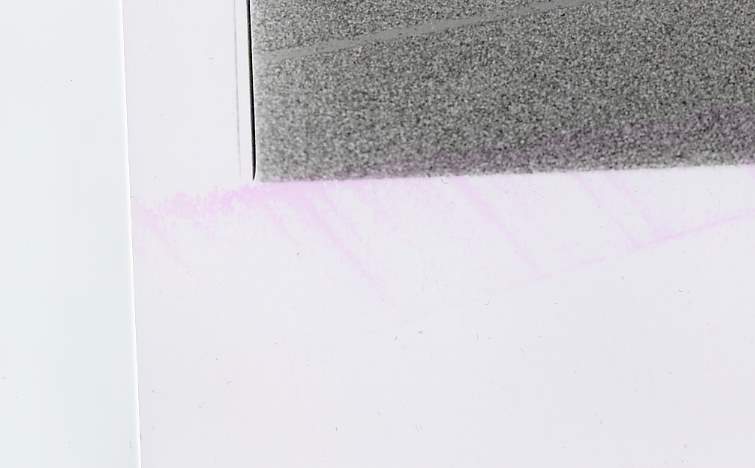
The image was developed, stopped, fixed and rinsed in the usual way. Nothing else.
Could this be down to the batch? I still have a whole pack of 24x30/50 with the same emulsion number.
Best regards
Stefan
acars1971
[...]
Then there’s this tiresome business of stopping with water. Who on earth started that stupid rumour that you can stop with water?
With baryta paper, it’s definitely nonsense, because the base is saturated with alkaline developer. The water splashes about a bit on the surface and, before you know it, all the alkali ends up in the fixer. Long before the fixer actually reaches its capacity limit, the acidity drops so sharply that the fixer gives up the ghost and simply fails to finish the process within the prescribed time.
[...]
Hi,
The whole ‘water stopping’ business was probably started by Maco.
I’ll quote from the technical instructions for Maco IR820c:
[color="red"]"If no acidic stop bath is used, an
intermediate rinse
of 2 x 30 seconds at 20 °C with constant agitation is recommended to
prevent the carry-over of developer residues into the fixer."[/colo
This paragraph also appears in the instructions for other Maco films. It can therefore be assumed that more than one person has read this note and taken it as gospel.
Regards
Christian
RomanJRohleder
Stefan,
You’ve clearly demonstrated what’s known as a dichroic fog. As I’ve already mentioned – this happens with flat fixers and when, when using a neutral/alkaline fixer, there hasn’t been enough ‘stop washing’... because then a little development continues in the fixer... Yuck.
_Finally_ I know where to point people. ;-))
Mirko, if you rinse thoroughly between development and fixing, it’s not a problem.
Preferably under running water. That’s how the FX-R works on paper too, if necessary. Yes, I tried it when my Foma Variant developed pink spots and will happily go back to the thin citric acid rinse in future... once my darkroom is up and running again.
Do keep an eye on the silver load in the fixing bath for a while using an AI test; that way you’ll quickly get a feel for how far you can go and how quickly metal builds up in the bath.
Roman
Gast
The practice of stopping the water was popularised by Anchell/Troops (Film Developing Cookbook) and T. Wollstein, who copied their work – due to the risk of so-called pinholes, which can form in the emulsion layer as a result of CO₂ build-up. Some say there are films where this is a genuine problem...
But never with paper. If something can go wrong, it will go wrong.
Ferdinand
acars1971
Well, so it wasn’t Maco after all, but Anchell/Troops and T. Wollstein – though that doesn’t make the whole thing any better!
I’ve been using acetic acid to fix various films and papers for years and have never had any problems with so-called ‘pinholes’.
Besides, it’s not as if acetic acid – or citric acid, for that matter – is among the most expensive photographic chemicals – quite the opposite, in fact – so the argument that you can save a fortune simply by doing washing without acid doesn’t hold water either.
So why take the risk of encountering problems with the fixer due to insufficient stopping, when the economic benefit is negligible or non-existent? And that’s without even taking into account the necessarily longer rinsing times when acid is omitted...
Christian
RomanJRohleder
So why take the risk of encountering problems with the fixer due to inadequate stopping, when the economic benefit is negligible or non-existent? And that’s without even taking into account the fact that omitting the acid inevitably leads to longer rinsing times...
Christian
A little anecdote – I no longer use a stop bath for film since I saw the emulsion slip off an Efke KB100 – despite the hardener in the fixer and, as a test in a subsequent attempt, omitting the stop bath (acetic acid back then; today I’d probably use citric acid). The problems were solved.
The film must have been a Zagreb production; I haven’t tested this empirically, but it’s worked well for me. As has pre-rinsing. Dichromates wouldn’t cause any great difficulties with film either.
In the case of a thoroughly alkaline process, a stop bath would also mess things up and result in necessarily extended rinsing times.
Anyway – never change a running system. ;-)
Regards, Roman
StefanHeymann
Just to clarify:
- I now use an acidic stop bath (2 tablespoons of Heitmann citric acid powder to 1 litre of water) when processing Polywarmton RC *)
- I fix in Tetenal Superfix Plus 1+4 for 90 seconds (Tetenal recommends 30–60 seconds at this dilution; the 90 seconds are Mirko’s suggestion).
The pink tinge remains, even when the fixer is brand new. I prepare a fresh stop bath before every session (lasting approx. 2–3 hours). The pink tinge usually disappears during rinsing. I use it as a sort of ‘rinse indicator’...
I’ll be switching to Maco Ecofix soon (I’ve already got the bottles) — let’s see what happens then.
Best regards, Stefan
*) Strictly speaking, for all papers, but I now call them all ‘Polywarmton RC’ :-)
StefanHeymann
P.S.: I’m now using Maco Ecofix and the pink discolouration has gone. It was probably down to the Superfix Plus.
Best regards, Stefan
